One concerning thing that I find myself working with a decent number of folks on is cutting. It seems more common than I would have thought, especially in adolescents and young adults. It's not a new phenomenon, but it does seem to be happening more now because kids are hearing about it and trying it out for themselves. While overall it is still a socially unacceptable practice, I think there likely is more acceptance of it with adolescent peers. I haven't gotten the impression that it is considered "cool", but I think there is less stigma around it in the younger population.
Cutting is something I have never been inclined to do. In order to better understand it, I've had to do research and also get information from folks I work with who do it. Cutting typically IS NOT simply a cry for attention. Most of the time when folks do it, they do it on a part of their body that is relatively easy to conceal (arms, upper legs, sometimes abdomen) because they don't want other folks to find out. If it isn't a cry for attention or help, then why do people do it?
I almost didn't include this image. It's hard to look at. However, this topic is hard to talk about anyway, and this is the main reason people do it. Although it seldom lasts long, individuals who cut swear that it takes away their mental/emotional pain, even if only for a minute. Physical pain (of any sort) causes the release of endorphins in our bodies that act to reduce pain. When an individual causes physical pain and then goes through the healing process for it, they feel better and are able to temporarily ignore their emotional pain. A cut or cuts may represent the emotional pain they experience, but are easier to manage. It can also give people some sense of control over the pain in their body. Finally, a physical cut is something that can be seen, it is real; although emotional pain is absolutely as real, because we can't see it it may feel less real to some people.
Cutting is generally not a suicide attempt. However, it is still a risky practice and so one we want to stop and prevent. Cutting may result in scarring that will be present the rest of the life, and most people really don't want that. While I have heard people state that they want the scars to remind them of what they have been, in most cases this isn't a permanent sentiment. More importantly, cutting can result in unintentional injury, sometimes of a serious nature. A cut that accidentally goes too deep or hits a major vessel can become an emergency situation.
Treatment for cutting involves identifying and implementing alternative coping skills. While we absolutely should communicate to people who are cutting that it is not a healthy practice, and parents absolutely can limit access to devices to cut with (although, honestly, if someone wants to cut they will find something - in a pinch paper will do the trick), people will not stop until they have other ways to deal with their emotional pain. I don't believe punishment for cutting is appropriate, other than taking away objects they can use which may include personal property like pocket knives. Folks who cut should be approached with care and compassion, and psychotherapy is the best treatment. For those of us who don't understand it, cutting can be a really scary practice. Fortunately, it is a practice that can be halted with supportive therapy.
Showing posts with label depression. Show all posts
Sunday, March 26, 2017
Tuesday, March 14, 2017
Am I my mental illness?
Most of the folks I work with meet the criteria for one or more mental illnesses; I meet the criteria of one (Major Depressive Disorder). For some folks it's a temporary thing - you are feeling sad/depressed, but it is linked to something that you will deal with, and then you will no longer meet the criteria. This is especially common for things such as depression and anxiety. For others, your mental illness is something you are going to live with for much of your life. You will learn ways to cope with it, you will be able to effectively manage it, but it is going to be something you will have to address on and off, possibly for the rest of your life.
For those of us who do live with mental illness long term, it can become very easy to identify with our mental illness. I could think about myself as a depressed person, but that isn't accurate most of the time. Yes, there are times when I have to actively manage depression, times when I experience depression, times when I suppose I am a depressed person. But it would be unhealthy for me to incorporate depression into my sense of self. I live WITH depression, but I AM NOT depression. While it may be a part of my life, it does not define me.
If I identify with depression, I am giving depression power and control in my life that it doesn't deserve. By making depression part of my sense of self, I am guaranteeing that it will play a prominent role in my life. I don't want depression to play a prominent role in my life. I accept it is a part, but I do not accept that it is who I am.
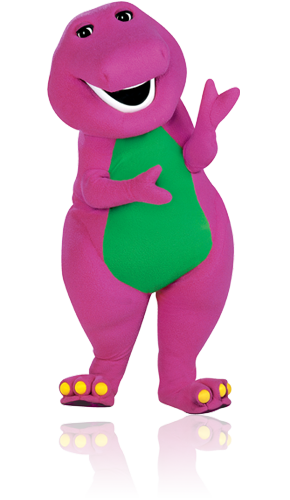
For a long time now, I have used a visualization for my depression. This is what my depression looks like:
except the creature is all green, not purple. It is a ghastly obnoxious dancing green dinosaur. It is not of me. It is a separate entity that at times I have to attend to. Sometimes it is much harder to do this, to maintain the distance needed to control the beast. I have lived with it for over 30 years now, but it will never be me. Barney the Depression Dinosaur, you will never get to be me.
For those of us who do live with mental illness long term, it can become very easy to identify with our mental illness. I could think about myself as a depressed person, but that isn't accurate most of the time. Yes, there are times when I have to actively manage depression, times when I experience depression, times when I suppose I am a depressed person. But it would be unhealthy for me to incorporate depression into my sense of self. I live WITH depression, but I AM NOT depression. While it may be a part of my life, it does not define me.
If I identify with depression, I am giving depression power and control in my life that it doesn't deserve. By making depression part of my sense of self, I am guaranteeing that it will play a prominent role in my life. I don't want depression to play a prominent role in my life. I accept it is a part, but I do not accept that it is who I am.
For a long time now, I have used a visualization for my depression. This is what my depression looks like:
except the creature is all green, not purple. It is a ghastly obnoxious dancing green dinosaur. It is not of me. It is a separate entity that at times I have to attend to. Sometimes it is much harder to do this, to maintain the distance needed to control the beast. I have lived with it for over 30 years now, but it will never be me. Barney the Depression Dinosaur, you will never get to be me.
Friday, February 17, 2017
Emotions: the Good, the Bad, and the Ugly...
Emotions. Some of us are all in tune with our emotions while others avoid emotions like the plague. Sometimes in therapy we focus on them while other times we focus on other things. When we think about emotions, we know there are lots of them...
Lots of times one of the things people want when they go to therapy is to stop feeling certain emotions. Frequently clients tell me they don't want to feel sad, anxious, depressed, angry, lonely, or scared. But is it a good goal to want to eradicate these feelings from our lives?
Most of the time, emotions serve a useful purpose (note I didn't say a pleasant purpose). Negative emotions alert us that there is something in our environment we need to attend to. Anxiety tells us there is something we need to attend to, to fix. If we are anxious about money, we need to take steps to improve our financial situations. When we are frustrated, perhaps we need to work something out with our spouse, co-workers, or friends, to alleviate the frustration. Fear lets us respond to keep ourselves safe. Sadness is a normal response to loss in our lives.
There are certainly times that emotions are too extreme. People may experience anxiety that is bad enough that it actually prevents them from responding. Depression may be so crippling that it is almost impossible to function. When emotions are this extreme, it is certainly reasonable to want them to go away, because in these cases they aren't being helpful.
None of us likes to feel bad, but emotions - the good, the bad, and the ugly - normally do serve a purpose. Therapy can help us reduce the extreme emotions, and it can help us learn to cope with emotions so that we can work through them. As nice as it might be to never experience the negative stuff, they are important and we need to learn from them and react in appropriate ways. When we actively address them, we can learn and grow, and that's a pretty great goal.
Lots of times one of the things people want when they go to therapy is to stop feeling certain emotions. Frequently clients tell me they don't want to feel sad, anxious, depressed, angry, lonely, or scared. But is it a good goal to want to eradicate these feelings from our lives?
Most of the time, emotions serve a useful purpose (note I didn't say a pleasant purpose). Negative emotions alert us that there is something in our environment we need to attend to. Anxiety tells us there is something we need to attend to, to fix. If we are anxious about money, we need to take steps to improve our financial situations. When we are frustrated, perhaps we need to work something out with our spouse, co-workers, or friends, to alleviate the frustration. Fear lets us respond to keep ourselves safe. Sadness is a normal response to loss in our lives.
There are certainly times that emotions are too extreme. People may experience anxiety that is bad enough that it actually prevents them from responding. Depression may be so crippling that it is almost impossible to function. When emotions are this extreme, it is certainly reasonable to want them to go away, because in these cases they aren't being helpful.
None of us likes to feel bad, but emotions - the good, the bad, and the ugly - normally do serve a purpose. Therapy can help us reduce the extreme emotions, and it can help us learn to cope with emotions so that we can work through them. As nice as it might be to never experience the negative stuff, they are important and we need to learn from them and react in appropriate ways. When we actively address them, we can learn and grow, and that's a pretty great goal.
Labels:
anger,
anxiety,
depression,
emotions,
fear,
feelings,
lonely,
psychologist,
sadness,
scared,
therapy
Subscribe to:
Comments (Atom)